In the world of freight, there is a physical truth that often gets lost in financial spreadsheets: every pound of equipment is a pound of lost profit.
For those of us operating in critical corridors like California, this isn’t just an operational detail—it’s the difference between an optimized trip and a wasted opportunity. The 80,000-lb gross vehicle weight limit is immovable; what we can move is the proportion of that weight that actually generates revenue.
The Physics of the Quarterly Balance Sheet
Historically, the industry prioritized equipment “heaviness” as a proxy for durability. However, in 2026, with the national average cost-per-mile for dry van and intermodal freight hovering around $2.50–$2.70, efficiency must come from engineering.
By utilizing lightweight tractors and chassis, we tackle three financial fronts simultaneously:
-
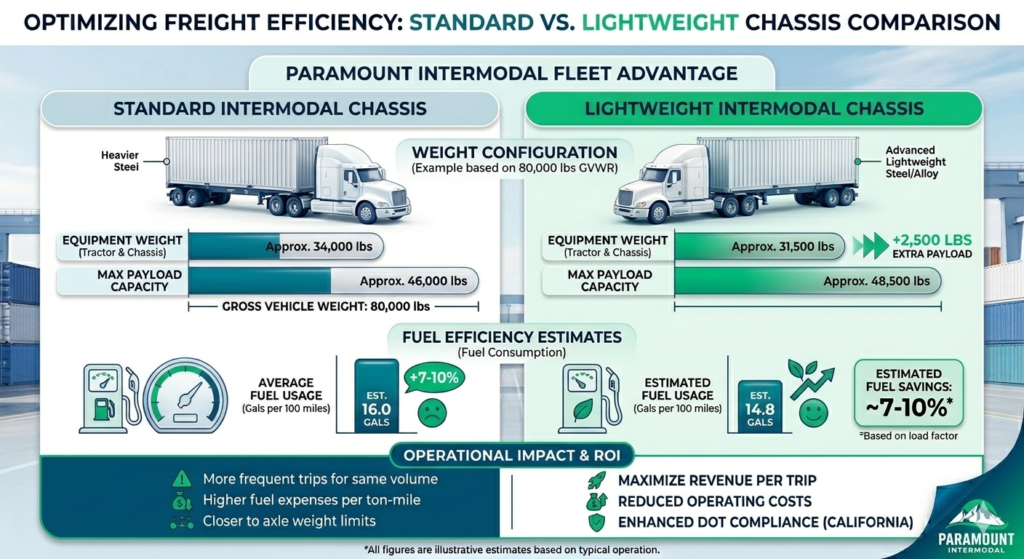
Payload Maximization: A setup that sheds 2,000 lbs of deadweight allows for that exact amount in additional cargo. For high-density shippers, this can reduce the total number of annual trips required to move the same inventory volume.
-
The Fuel Factor: Industry data suggests that for every 10% reduction in vehicle weight, fuel economy improves by roughly 5-7%. In high-volume operations, these marginal gains bridge the gap between a breaking-even and a profitable quarter.
-
Frictionless Compliance: California’s DOT regulations are famously stringent. Operating with a wider weight margin reduces the risk of scale fines and operational delays caused by axle overages (staying safely under the 34,000-lb tandem limit).
Beyond Savings: A Margin-Building Strategy
The logistics sector is shifting from a “cost-cutting” mindset to one of “margin construction.” It’s no longer just about spending less; it’s about making every asset work harder.
At Paramount Intermodal, we’ve found that transitioning to lightweight fleets isn’t just a technical preference—it’s a necessary response to a market where capacity is tight and rates demand flawless efficiency. For a logistics manager, partnering with optimized equipment means you are buying actual capacity, not just paying to transport steel and iron.
The Bottom Line: If your intermodal cost analysis doesn’t account for the tare weight of your provider’s equipment, you are likely leaving money on the highway.